Capacity and output answer different questions. Capacity describes stored charge or energy; output power describes how much power a bank can supply under specified conditions. A larger mAh number does not establish faster charging or suitable laptop output.
Start with the device you need to charge, then consider how much energy to carry and how you will recharge the bank itself. This guide explains the labels; it does not rank power banks or report hands-on tests.
Read the units · Check output · Plan recharging · Check pass-through
mAh, Wh and W: three different labels
| Label | What it describes | What it does not establish |
|---|---|---|
| mAh: milliamp-hours | Charge capacity, which needs a voltage basis to relate it to energy | An exact number of phone charges or a charging speed |
| Wh: watt-hours | Energy capacity | The output power available from a particular port |
| W: watts | Power, such as a documented output or input limit | How much energy the battery stores |
To relate charge capacity to energy, use Wh = (mAh ÷ 1,000) × battery voltage. The FAA’s battery guidance gives the equivalent calculation using amp-hours and voltage.
As a purely illustrative calculation, 10,000mAh at 3.7V equals 37Wh. The same charge figure at 3.85V equals 38.5Wh. These are arithmetic examples, not specifications for a product in our catalogue. Do not assume that every power bank uses either voltage.
Prefer the manufacturer’s marked Wh rating. If you need to calculate it, use the battery voltage that corresponds to the stated capacity, not a USB output voltage selected from a port’s charging profiles. If the basis is unclear, keep the energy figure unconfirmed rather than making the label appear more precise than it is.
Why 20,000mAh does not promise four full phone charges
Dividing a bank’s advertised mAh by a phone battery’s mAh skips important information. The figures may use different voltage bases, conversion is not lossless, and the phone may consume energy while it charges.
Anker’s capacity explanation distinguishes internal-cell capacity from output capacity at a different voltage and discusses conversion-circuit losses. Its example is not a universal efficiency figure for every bank, cable or charging method.
Look for manufacturer-stated usable output capacity and its test conditions when available. Even a useful capacity specification is not our independent measurement of full phone recharges. Without matched evidence for the bank, device and usage conditions, the charge count remains unknown.
Can a large power bank charge a laptop?
The capacity headline cannot answer that. Check your laptop manufacturer’s charging guidance, then the bank’s documented output from the port you intend to use. Confirm the charging profile, connector and cable capability as well as wattage.
For a hypothetical laptop setup requiring 65W, a bank documented for only 20W output does not cover that full requirement, regardless of its mAh figure. This does not prove that the laptop cannot accept any charge at a lower power; that behaviour needs model-specific guidance.
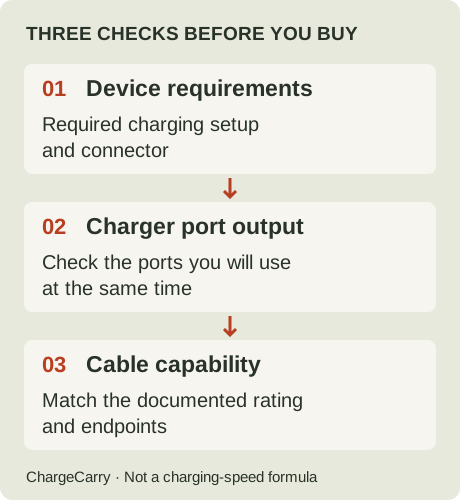
ChargeCarry illustration: for this decision, the source is the power bank’s output port. Stored energy is a separate check.
The USB-IF Power Delivery overview explains power management in which devices take the power they require. A higher maximum output label is not a promise of a shorter charging time for your device.
When charging two devices, find the bank’s exact shared-port output combination. Do not add individual port maxima and assume both are available together. Our power-sharing table walkthrough explains the reading method; use the actual power bank’s documentation for its figures.
Input is how you refill the power bank
Output sends power to your device. Input receives power to recharge the bank. A high output rating alone says nothing about the bank’s input limit or whether your existing wall charger supports its fastest documented refill setup.
Before buying, check the input port, supported input profiles, required cable and the conditions behind any advertised recharge time. Do not assume a port supports both directions just because it is USB-C. Likewise, simultaneous input and output needs explicit support in the manual; a list of input and output ratings alone does not establish it.
For a trip with short stops at wall outlets, the refill arrangement matters alongside energy capacity. Compare the complete setup you will carry rather than choosing only the largest capacity number.
Can you charge a power bank and phone at the same time?
Only plan around simultaneous input and output when the exact power bank documents it, including the conditions. This is often called pass-through charging. Separate input and output specifications do not by themselves answer the question.
For a concrete manufacturer example, Anker’s guidance for its Power Bank (25K, 165W, Built-In and Retractable Cables) requires at least 20W input to enable pass-through. Below that, it describes self-recharging only. It also describes output limits tied to input power and the number of output ports. This is evidence for that named product’s documented mode, not for every Anker bank or another regional variant.
The useful buying question is therefore not simply “does it support pass-through?” Ask whether the supported arrangement covers the charger, ports and devices you intend to pack.
| Check | Record from the exact documentation | Keep unresolved when |
|---|---|---|
| Mode support | Explicit simultaneous input/output instructions | Only separate input and output maxima appear |
| Incoming power | Input conditions and required charger/cable | The wall charger’s total label is your only evidence |
| Outgoing power | Limits for the occupied output ports in that mode | Only battery-only output ratings are listed |
| Bank refill | Whether and how the internal battery recharges in the arrangement | Power reaching the phone is the only observation |
This worksheet is our planning method. It does not establish how an untested bank distributes energy or how long either battery will take to fill. Check the charger’s shared-port table if another device occupies the wall charger: the bank’s actual input arrangement must still meet its documented conditions.
Plan a hotel charging stop before buying a bigger bank
Write two separate goals: charge the phone for the next outing and refill the bank for later. Then choose a documented arrangement:
- Separate charger outputs: check the charger’s shared-port limits and the bank’s input requirements. Count both cables in your packing list.
- One output, sequential charging: decide which device needs attention first and leave time for the other. This avoids making your plan depend on an unverified simultaneous mode.
- One output through the bank: use only the bank’s documented pass-through conditions. Confirm the phone output and bank refill behaviour separately rather than assuming both receive their standalone maximum.
A pass-through label alone does not establish uninterrupted backup power when wall power disappears. If continuous operation matters, obtain explicit documentation for that requirement; this guide has not tested switchover behaviour.
Before departure, check your intended setup against the manuals and observe it while in use according to their instructions. If a mode remains undocumented, keep a separate or sequential charging plan. Do not buy a larger mAh rating to solve a missing input/output capability. Use the travel charging checklist to record the unresolved connections.
Before flying, check the energy label and the current rules
As checked October 20, 2026, the FAA’s U.S. PackSafe guidance requires power banks in carry-on baggage, with terminals protected against short circuit. If a carry-on bag is gate-checked, power banks must be removed and kept in the cabin. The FAA also notes that airlines may impose stricter quantity and Wh limits.
Read the full current guidance and your operating airline’s rules for your itinerary, including carriage, storage and onboard use. A retailer’s “airline approved” phrase or a calculated Wh figure is not permission for a particular flight. This article is not a complete aviation-rules checklist.
A practical buying note
Record these five items before comparing prices:
- Main device: its documented charging requirements and required cable.
- Output: the exact port and simultaneous-use combination you need.
- Energy: marked Wh, with mAh and the corresponding voltage if relevant.
- Refill: input requirements and whether your wall charger and cable meet them.
- Packing: actual size, weight and the applicable travel restrictions.
Use the travel charging checklist to collect missing information. For cables you already own or plan to pack, see length and quantity and 60W vs 100W capability.
We do not yet have a verified power-bank shortlist to recommend. This guide contains no power-bank purchase offer. Other product pages may include affiliate links; see our disclosure.
Sources and editorial note
Research by ChargeCarry. Published September 29, 2026. Updated October 20, 2026 with pass-through and refill planning. Official sources checked October 20, 2026:
- FAA: PackSafe — Lithium Batteries — Wh calculation and U.S. carriage guidance; page dated August 11, 2026.
- Anker: Why Is the Rated Capacity Marked on a Power Bank Lower Than Expected? — voltage basis and conversion losses.
- Anker: Pass-through charging in Power Bank (25K, 165W, Built-In and Retractable Cables) — model-specific simultaneous-mode input and output conditions; not a purchase recommendation.
- USB-IF: USB Power Delivery — device power requirements and power management.
Numerical scenarios are explicitly hypothetical. No charging-speed, efficiency or charge-count testing is claimed. Read our research method.